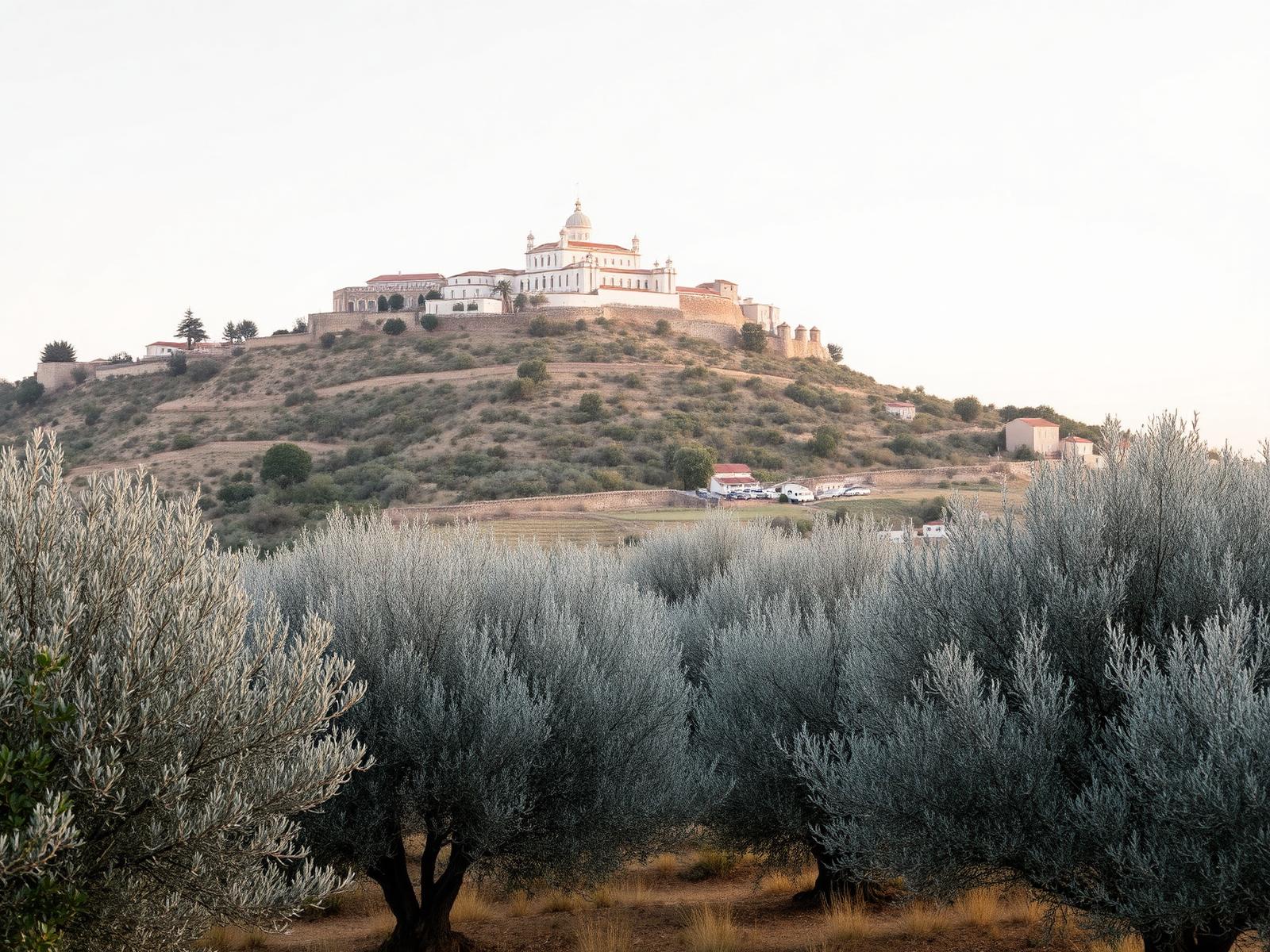
Castelo de Vide stands on a hill that has changed hands more times than its walls would suggest, and the olive trees below it have outlasted every one of those changes. They were here before the reconquest fixed this stretch of border between Christian and Muslim Iberia. They were here, by most accounts, before that — under Visigothic rule, and likely under Roman rule before that, when the olive was already inseparable from how this part of the world fed, anointed, and lit itself.
What is easy to miss, standing in a grove like this one, is that the olive tree has carried a second meaning for almost as long as it has carried its first. Across the civilizations that passed through this exact frontier — Roman, Visigothic, Arab, Christian — the olive branch meant the same thing before it meant anything agricultural: peace, endurance, a pause in hostility. It is one of the only objects in the human world that every regime occupying this valley would have recognized, without translation, as sacred.
A tree that asks you to slow down
There is a reason an olive grove feels different from a vineyard or a wheat field. The trees are old — genuinely old, some of them centuries old — and they grow slowly enough that nothing about them rewards hurry. Field noteTo verify — do you know of a specific tree near Castelo de Vide with a known or estimated age, or a family grove worked by the same family for generations? Even an approximate, honestly caveated age is more valuable here than a precise but unverifiable one. Their silver-green canopy moves with even a faint wind, which is part of why so many older traditions in this region treated the olive grove as a place apart — not quite wild, not quite cultivated, somewhere to think rather than simply to work.
This is the instinct Borderland Olive is built around: that the most honest way to encounter this landscape's two thousand years of frontier history is not to read about it, but to sit inside the part of it that never stopped growing. The castle tells the story in stone. The olive grove tells it in something closer to breath.
What this looks like, in practice
We don't ask you to choose between the contemplative and the agricultural — the grove holds both, and so do we. At the centre of what we offer are slow, guided practices held directly among the trees: meditation, yoga, pranayama breathwork, and an olive oil ceremony that pairs ritual with the frontier history of this specific ground. InsertOne sentence on who guides these: your own role, or a named practitioner/partner, however you want this framed. Visits to a working lagar, and tastings of what comes out of this year's harvest, sit alongside these practices as a complement — a way to taste the same ground you've just sat still in, not the main event.
Groups stay deliberately small. InsertExact group size cap and the reasoning, if you want to state it. This isn't a tour. It's closer to a retreat that happens to be built around one tree.
Where to stay with this
Two houses hold this experience, each in a different register. Casa Amarela — an 18th-century classified building, a national monument — gives the historical weight of the frontier its proper setting. Casa do Parque offers the same proximity to the groves in a contemporary, comfortable register, for guests who want the stillness without the patina.
For the stone-and-history version of the same place, see Templar Borderlands' page on Castelo de Vide.